Case study
Service NSW
Designing one better map for NSW Government services
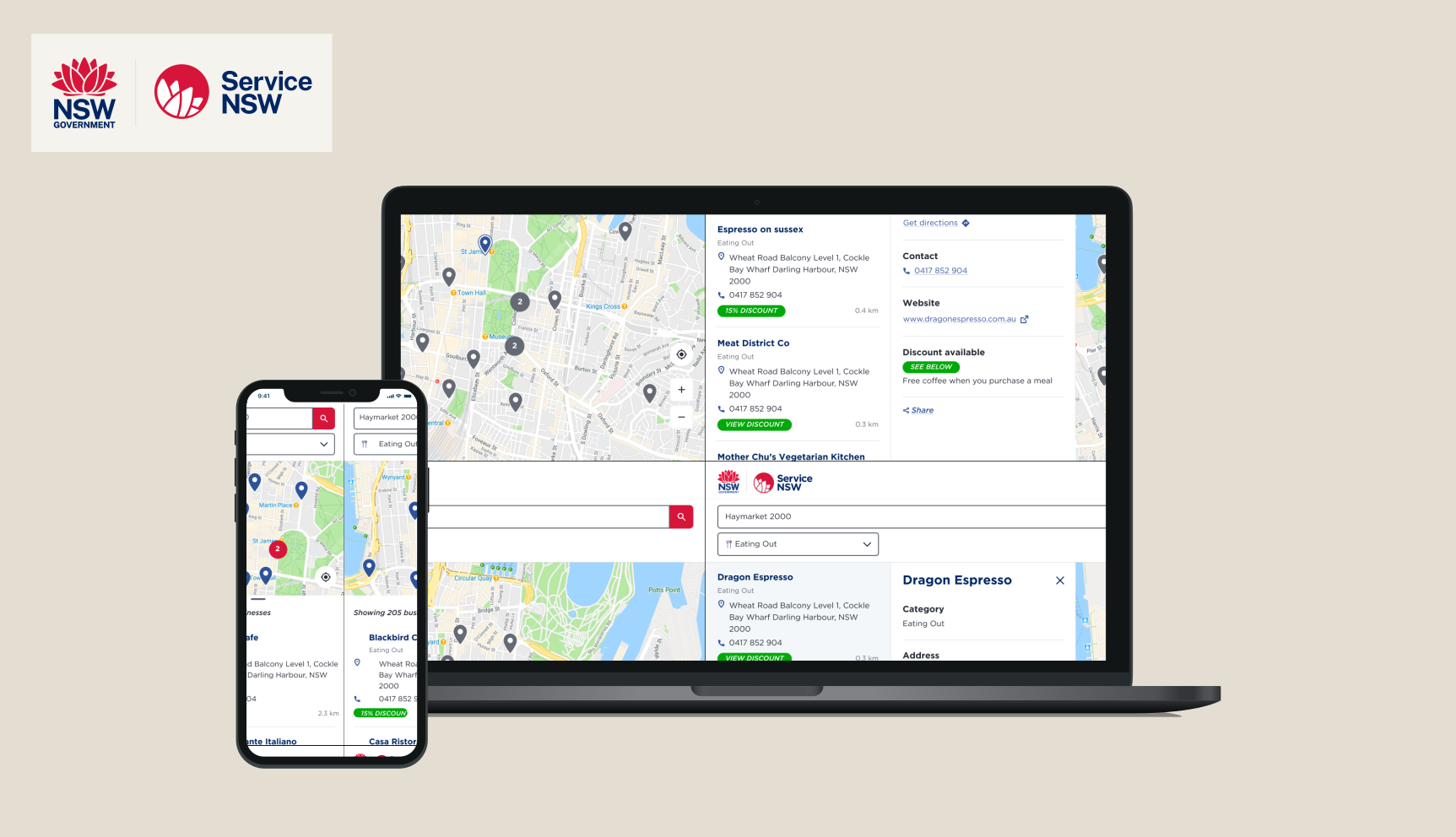
Across NSW Government services, different maps had evolved for different purposes. They looked and behaved differently, and didn’t always provide the functionality or accessibility people needed.
Service NSW set out to create a more consistent mapping experience that could work across services, starting with research and testing with NSW Seniors Card holders.
The brief started with a candid assessment.
Reviewing the map being used for Dine & Discover vouchers, Victor Dominello wrote: “It’s ok - but it’s not great.”
And it wasn’t the only map.
My Community Project and the Early Childhood Education finder had their own mapping experiences, with differences in functionality including filters, pin clustering and list views.
The opportunity was bigger than improving any one of them.
Quick facts
Airteam worked with Service NSW to design and build a consistent, accessible mapping experience that could be applied across government services.
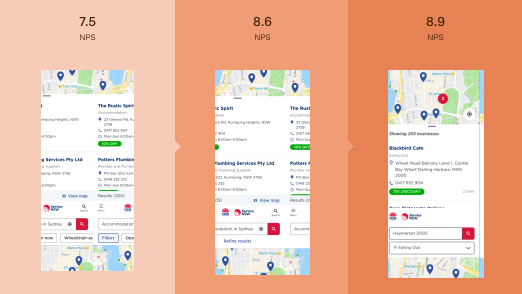
The design went through three rounds of research with senior citizens, with average user ratings increasing from 7.5 to 8.9 out of 10.
The resulting map meets WCAG 2.1 AA accessibility standards, and became part of the redesigned NSW Seniors Card experience - helping card holders find participating businesses while making it significantly faster for those businesses to manage their offers.
- Client: Service NSW
- Industry: Government
- Services: User research and testing, UX and interaction design, information architecture, accessibility, prototyping, development
One map, many government services
Service NSW is a major digital gateway between the NSW Government and the people and businesses it serves.
But different services had developed different approaches to mapping.
That created inconsistencies in how people searched, filtered and navigated results. Some maps lacked features such as pin clustering or list views, while differences in content structure made it harder to create a predictable experience from one service to the next.
Service NSW wanted to establish a better foundation: a mapping experience that could work consistently across different services and different audiences.
That meant solving four related problems:
- Consistency: establish common mapping patterns and functionality.
- Accessibility: make location information usable by people with different access needs.
- Information architecture: create a clearer structure for categorising and finding services.
- Flexibility: design patterns that could work across different government programs rather than solving for a single map.
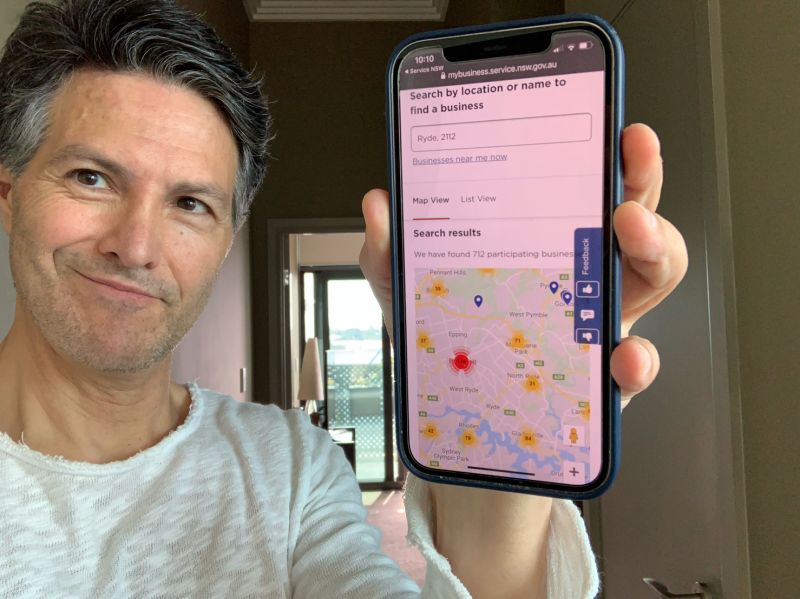
Designing with seniors
The team started with an audience that would put the experience to the test: senior citizens.
Airteam reviewed Service NSW’s existing mapping experiences, looked at patterns used elsewhere and ran stakeholder workshops to understand the requirements across different services.
We then took prototypes through three rounds of research with seniors, using interviews, surveys and usability testing to understand where people were getting stuck.
Each round informed the next.
Average user ratings increased from 7.5 to 8.6, then 8.9 out of 10 as the experience was refined.
That iterative process gave the team evidence for design decisions before they became part of the finished product.
And while seniors were the primary research group, many of the improvements made the map easier to use for a much wider audience.
A map isn’t accessible if the map is the only option
One of the most important decisions was to provide the same information in two ways.
Every location shown visually on the map is also available through a text-based list.
That matters because not everyone can interpret or navigate an interactive map. Screen reader users, people navigating with a keyboard and people who simply find a list easier to scan still need access to the same information.
Other improvements included clearer filtering, pin clustering at wider zoom levels and layouts designed to work across desktop, mobile and higher zoom levels.
The resulting experience meets WCAG 2.1 AA.
For any public-facing mapping product, there’s a useful principle here: design the list alongside the map - it’s a variant of a key view, not an edge-case interaction.
One team from research to build
Airteam led the design process from research and information architecture through interaction and interface design.
Development brought together Airteam developers, additional contractors and Service NSW’s own team, all working from the same designs.
That continuity mattered because the decisions being made weren’t purely visual.
Information architecture affected search. Accessibility affected interaction patterns. Research findings affected functionality. And all of those decisions needed to survive the transition from prototype to production.
Keeping design and development connected helped carry that reasoning into the finished experience.
Putting the map to work for Seniors Card
The new mapping experience became part of a wider redesign of the NSW Seniors Card program.
For card holders, it created a clearer way to search by category and find participating businesses and their current discounts.
The changes also improved the experience for businesses managing those offers.
Existing businesses could update offers and discounts online in around two minutes, compared with a process that had previously taken weeks.
New businesses could register for the program in under ten minutes, supported by real-time ABN lookup and address pre-population.
Service NSW for Business could consequently process hundreds of new business registrations a week online, compared with around 15 paper applications a month previously.
The result demonstrated how a shared digital pattern could improve an individual government service while creating something that could be reused more broadly.
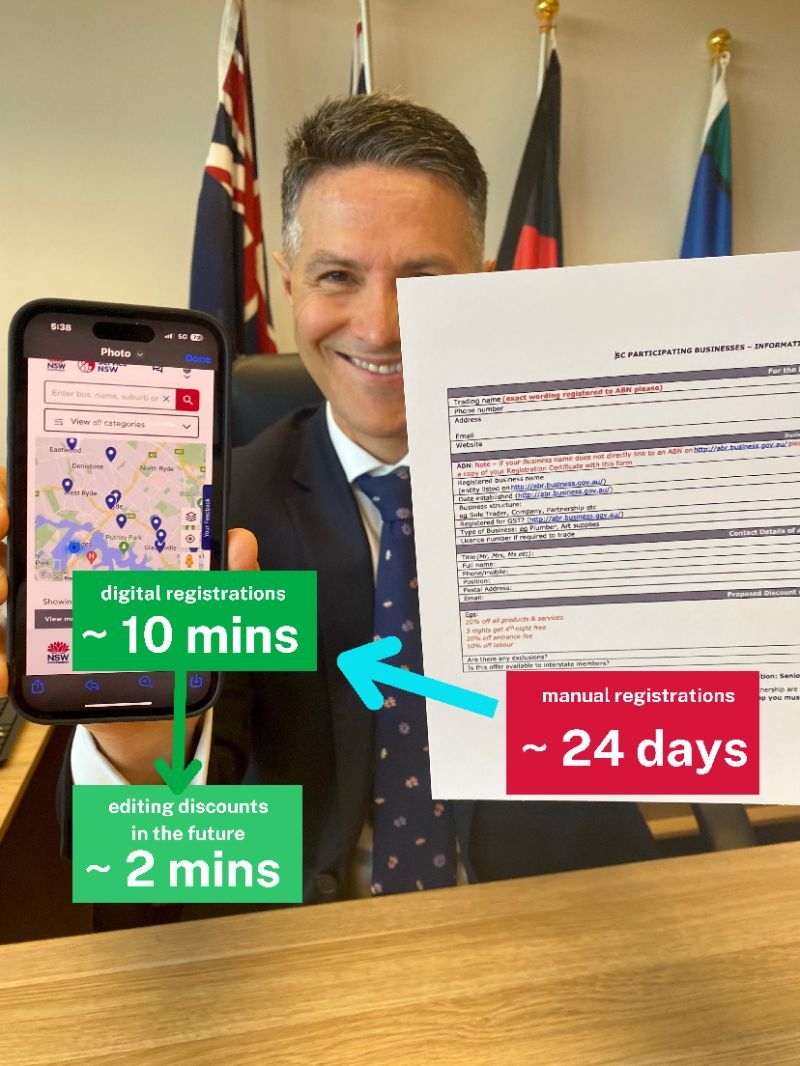
The new design and process received acclaim from users, internal stakeholders, and former Minister Victor Dominello:
“NOW…
Existing businesses:
- can edit and update offers and discounts online in about 2 mins via their Service NSW for Business Profile, where as previously, this would have taken weeks to update.
New businesses:
- can register/set up a Business Profile and join the Seniors Card program in less than 10 minutes - instead of weeks. You use real-time validation fields such as ABN look-up, pre-population of address field etc, and you can add/manage your discounts as and when you need. The process is straight through - if not, further documentation may be required.
NSW Senior Card holders:
- can access an online map - and search by categories - to locate participating businesses' offers and discounts.
Changes to discounts:
- are updated on the seniors' card map in close to real-time
THIS MEANS….
Service NSW for Business can register hundreds of new businesses every week via online applications - at the moment, only about 15 paper applications are processed per month.”
Built for government
Service NSW is one of several government organisations Airteam has worked with to design and build public-facing digital services.
Our 100% Australian-based team works within ISO 27001 security and ISO 9001 quality frameworks, with experience across accessibility, complex integrations, legacy systems and government delivery environments.
Airteam is also an approved supplier on the NSW Government ICT Services Scheme and an approved seller through the Australian Government’s Digital Marketplace and BuyICT, giving government teams established procurement pathways for engaging us.
Service NSW by the numbers
7.5 → 8.9
Average user rating across three rounds of research
~2 minutes
For an existing business to update an offer, down from weeks
<10 minutes
For a new business to register, down from weeks
Hundreds a week
Businesses able to register online, compared with around 15 paper applications a month