Case study
ViewJobs
2,000+ regional jobs in the first month, before any marketing.
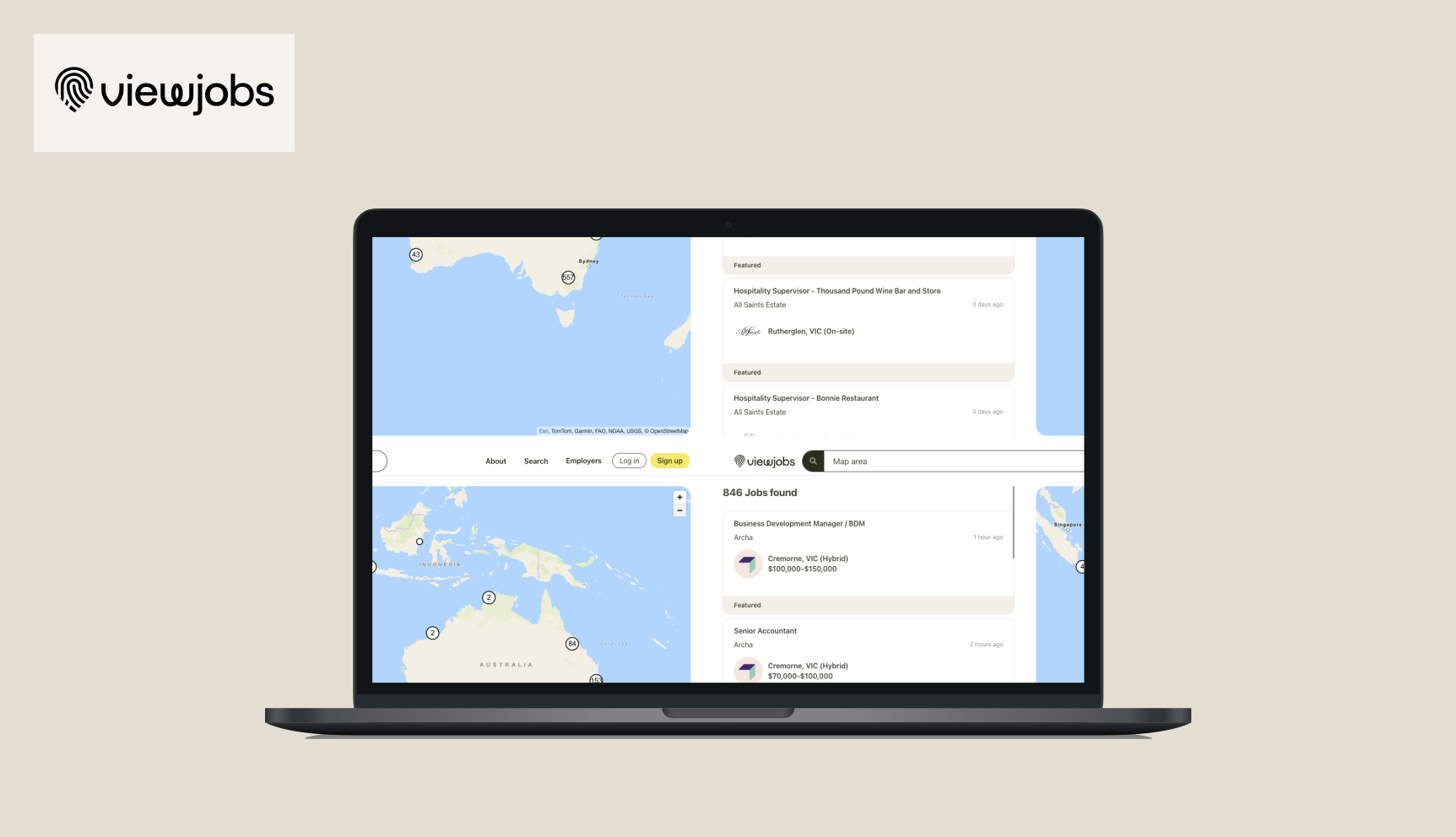
ViewJobs set out to build Australia’s first job platform dedicated to regional careers. Within a month of its soft launch, it had more than 2,000 listings and reached four times its forecast classified revenue.
Most job boards start with the role. ViewJobs starts with the place.
Its search is built around an interactive map, letting jobseekers explore a career alongside the town and lifestyle that come with it. It’s a different way of thinking about job search, built around the idea that moving to a regional area is often a lifestyle decision as much as a career one.
Quick facts
ViewJobs launched a map-led regional careers platform integrated with Australian Community Media’s network of more than 100 brands. In its first month, before marketing activity began, it passed 2,000 listings and reached four times its month-one classified revenue forecast.
- Client: ViewJobs
- Industry: Employment and media
- Services: Custom platform development, cloud architecture, interactive map development
Building a marketplace around place
ViewJobs is a joint venture between Australian Community Media (ACM) and Lewis Romano, founder of SpotJobs and Credit Clear.
The opportunity was regional employment. Employers needed skilled workers, while people considering a move outside Australia’s major cities needed a better way to discover the careers and lifestyles available to them.
ViewJobs set out with three objectives:
- Launch a careers platform focused on regional opportunities
- Integrate with ACM’s network of more than 100 brands
- Let people explore careers and regional lifestyles together
That third objective shaped the product.
Instead of making location another filter in a traditional list of jobs, ViewJobs made it central to the search experience. Jobseekers can explore opportunities on a map and see where a role could take them.
From designs to a working platform
ViewJobs came to Airteam with its core concept and designs ready to build, following a referral from Robert Beerworth, a former Fairfax client.
The brief was clear: turn those designs into a working platform quickly, without making technical decisions that would limit where the product could go next.
Airteam Delivery Manager Ben Mullaley and Developer Nick Hu led the build.
“We needed to build a platform that was robust enough to handle a high volume of job listings and user traffic, and flexible enough to grow with ViewJobs’ ambitious plans,” says Nick.
The architecture balanced delivery speed with room to scale.
- Frontend: Next.js running on AWS Fargate behind a load balancer
- Map search: MapLibre with AWS Location Services
- Backend: Nhost, supported by microservices running on AWS Lambda and CloudFront
- Data: GraphQL through Hasura and Apollo Client
- Interface: Ant Design
AWS provided the infrastructure needed to scale as traffic and listings grew, while Nhost gave the team a faster route through the early stages of development.
The result was an architecture designed around the product ViewJobs needed at launch, with space for the roadmap beyond it.
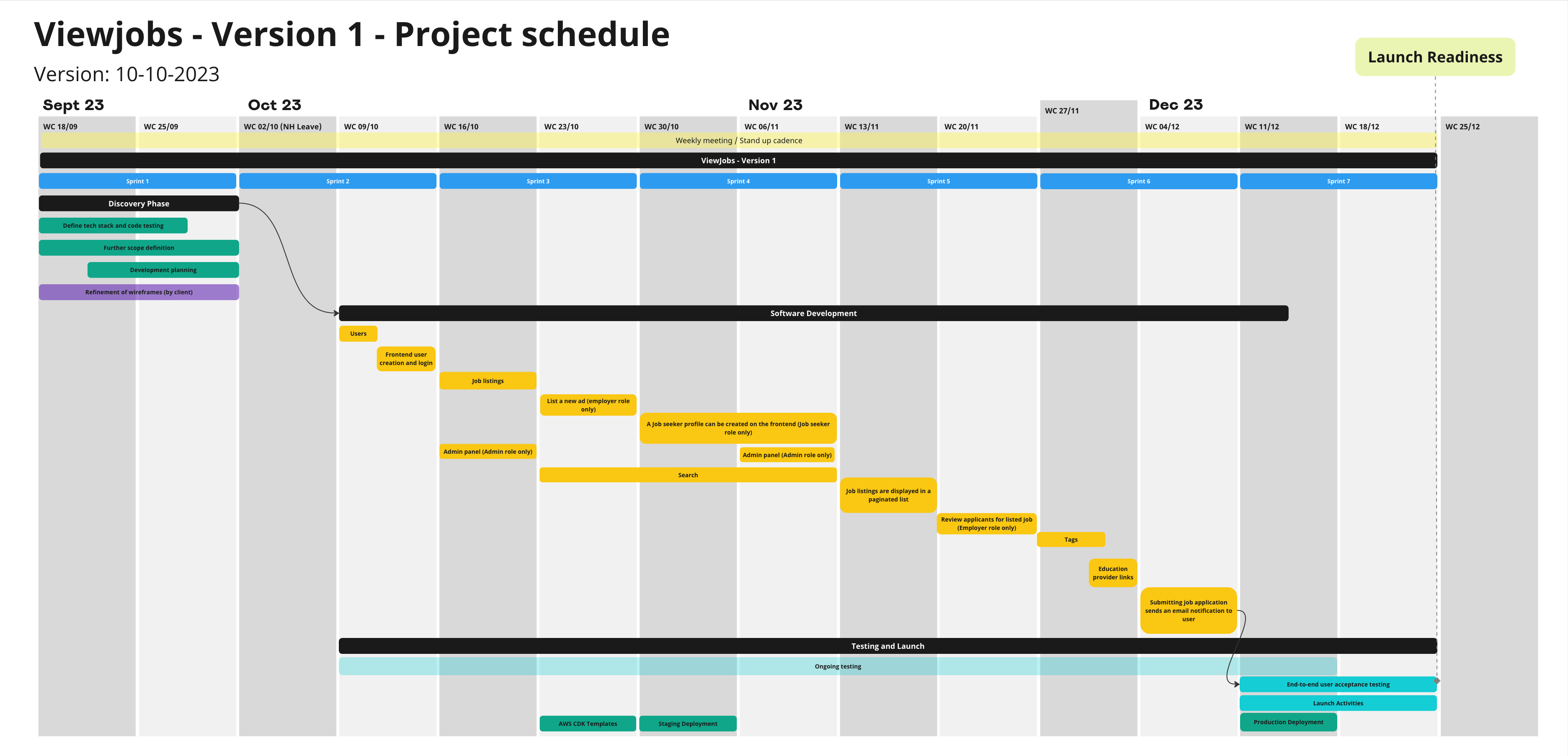
Our project plan for viewjobs focused on speed to implementation, supplemented by collaboration and frequent team check-ins.
Solving the marketplace problem before launch
A new employment marketplace needs both sides to work. Jobseekers need enough roles to make searching worthwhile, while employers need confidence that listing will put them in front of candidates.
ViewJobs chose to build the supply side first.
Before switching on marketing, it worked with a controlled pilot group of employers to populate the platform with real jobs. That meant the product could prove its value to employers while building enough inventory to give future jobseekers something worth exploring.
The first-month results suggest the approach worked.
More than 2,000 jobs were listed, with listings growing 34% week on week. Classified sales revenue reached four times ViewJobs’ month-one forecast. ACM also saw an uplift in classified print revenue, with the new digital product giving its sales teams more to offer existing clients.
There’s a useful principle here for anyone launching a two-sided marketplace: work out which side needs to be established first, and prove that before paying to bring the other side in.
Quantifiable success in connecting regional employment
Within just a month of entering the market, without any marketing activity, ViewJobs' strategy to first engage a controlled pilot group provided immediate value. "We’ve rapidly populated the platform with job listings, reaching over 2000 jobs listed within the first month and compounding 34% week on week. We expect this to significantly jump as we move out of soft launch and bring marketing activity online in the new financial year" said Jarrah Kammoora, Co-founder of ViewJobs, highlighting the platform's immediate traction. This early adoption and the growing number of job listings are testaments to the platform's seamless user experience and the acute demand for a dedicated regional job marketplace.
The results have not only been encouraging but also commercially significant. "In our very first month, we’ve quadrupled classified sales revenue against our month one forecast, heavily attributed to the product quality and its positioning within regional markets. We’ve also seen a strong uplift in classified print revenue for our partner ACM, as the digital offering provides a great value add to clients and opens broader conversations across their existing network." Jarrah shared.
Beyond the tangible metrics, the platform's strategic design has started to resonate with its user base. The map-led exploratory experience, as Jarrah described, allows job seekers to navigate employment opportunities in tandem with lifestyle choices, an emerging trend post-COVID. "Our platform is intentionally designed to prioritise the 'where' of job opportunities, aligning career moves with lifestyle aspirations," Jarrah elaborated. This unique approach is already fostering a community-focused environment that's expected to strengthen with the upcoming feature developments centred around regional profiles.
Making the map part of the product
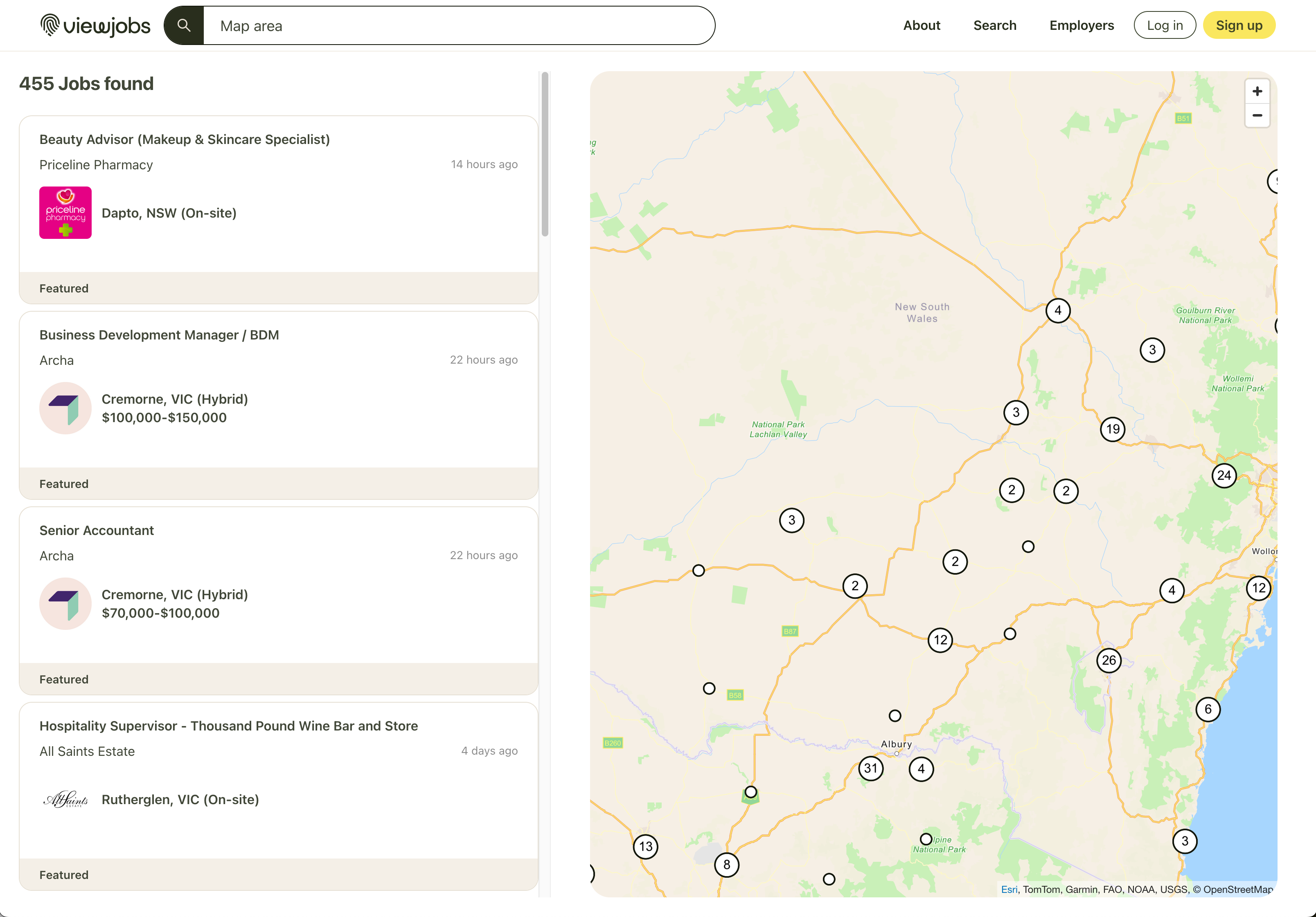
The map isn’t simply another way to display search results - it’s central to how ViewJobs wants people to think about regional employment.
“Our platform is intentionally designed to prioritise the ‘where’ of job opportunities, aligning career moves with lifestyle aspirations,” says Jarrah.
That meant the mapping technology had to work as a core part of the search experience, while still supporting the volume of jobs and geographic data behind it.
Using MapLibre with AWS Location Services gave ViewJobs a custom map experience that could sit directly inside the platform rather than sending users through a generic location search.
For a regional careers product, that distinction matters. The place isn’t metadata attached to the job. It’s part of the decision.
Building for what comes next
ViewJobs’ early launch validated more than the technology - it showed that employers would populate the marketplace, and that its regional positioning could generate commercial results before a wider marketing push.
The platform was also built with its next stages in mind.
ViewJobs’ roadmap includes vector-based candidate matching, using AI to improve how jobseekers and employers are matched and automate parts of the screening process.
That evolution can happen on top of the existing platform rather than requiring ViewJobs to rethink the foundations it launched with.
The first challenge, though, was simpler: build a regional jobs marketplace with enough real opportunities to be useful from the moment people arrived.
More than 2,000 listings in its first month gave ViewJobs a strong place to start.
ViewJobs by the numbers
2k+
Jobs listed in the first month
34%
Week-on-week listing growth
4x
Month-one classified revenue forecast
100+
ACM brands integrated