Case study
Healthdirect
Using conversational AI to free up Healthdirect’s clinical staff
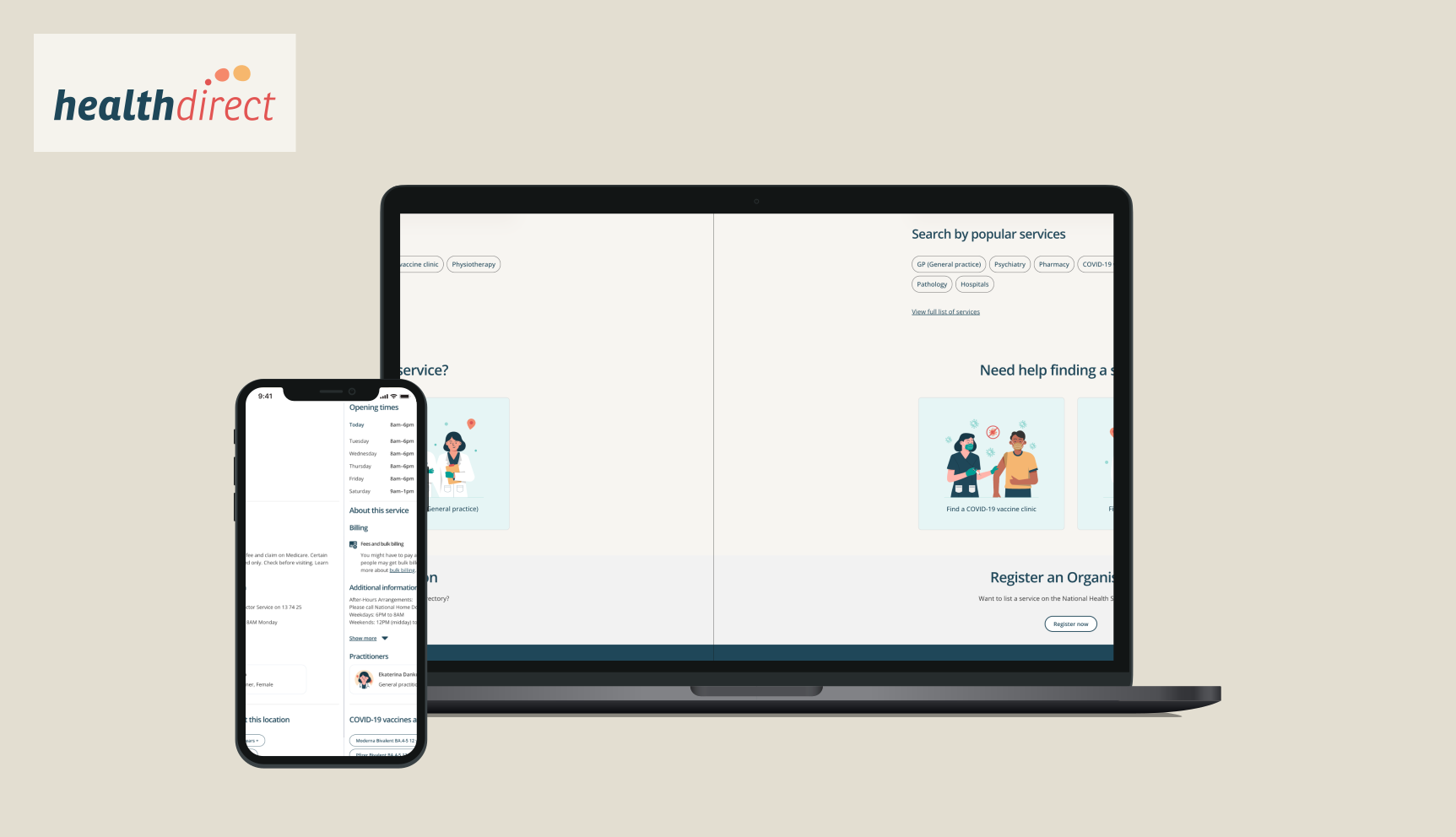
Healthdirect’s 24/7 helplines connect Australians with health information, advice and services.
Some callers need clinical guidance. Others simply need to find a nearby GP, pharmacy or other health service.
Healthdirect saw an opportunity to handle those predictable searches differently, using conversational AI to help callers find a service by speaking while keeping a nurse available whenever the conversation needed a human.
Quick facts
Airteam worked alongside Healthdirect’s development team to prototype and build a conversational voice bot connected to its national health services directory.
Callers can describe the service they’re looking for using natural speech and receive results by voice or SMS. The solution was initially built using Amazon Lex, before evolving into a combined AWS and Google Cloud architecture to improve speech recognition across different accents, speech patterns and timing.
- Client: Healthdirect Australia
- Industry: Healthcare and government
- Services: Conversational AI, natural language processing, cloud development, prototyping
Giving routine searches a different route
Healthdirect Australia provides 24/7 health information, advice and referral services for people across Australia.
Its helplines are staffed by registered nurses who assess callers’ needs and help connect them with appropriate care.
But not every call requires clinical judgement.
Some people already know what they need. They’re looking for a nearby pharmacy, GP or another health service and need help finding one through Healthdirect’s national directory.
Those searches tend to follow a predictable pattern: what service do you need, and where do you need it?
That made them a useful candidate for automation.
If callers could complete routine directory searches without waiting for a nurse, Healthdirect’s clinical staff could spend more of their time on conversations that required their expertise.
Building a conversation, not a search form
Airteam worked alongside Healthdirect’s development team, delivering prototypes and proof-of-concept features in short cycles so they could be tested and refined before moving further.
The interaction needed to work through speech.
A caller describes the service they’re looking for. Natural language processing interprets the request, identifies what they’re searching for and returns relevant results from Healthdirect’s directory.
Those results can then be delivered through the call or sent to the caller by SMS.
That sounds straightforward when written down - but speech rarely is.
People pause. They interrupt themselves. Accents vary. The same place or service can be described in different ways. Timing that feels natural for one caller can feel awkward for another.
The technical challenge was making the conversation tolerant of that variability.
When one speech service wasn’t enough
The first version of the bot was built using Amazon Lex.
Testing exposed opportunities to improve how accurately the system recognised different voices and speech patterns, so the architecture evolved rather than forcing the original technology to solve every part of the problem.
Airteam and Healthdirect moved to a blended AWS and Google Cloud solution, supported by open-source voice-matching libraries.
Combining services gave the team more flexibility to improve voice recognition and the accuracy of how requests were interpreted.
It’s a useful principle when building with AI services: choose technology around the behaviour you need, rather than designing the experience around the limitations of one platform.
Designing the way out
Accuracy wasn’t the only requirement. An automated health service also needs to know when automation should stop.
A caller might begin by asking for a nearby pharmacy and then say something that needs clinical attention. Another might simply struggle to make themselves understood.
In either case, the automated conversation shouldn’t become a barrier between that person and a qualified health professional.
So the route to a nurse was built into the experience. Callers can leave the automated conversation and speak to a person whenever they need to.
For AI in healthcare, that’s an important design decision: work out how a person gets back to a human before deciding how much you can automate.
The objective is to use automation where it makes sense while preserving human judgement where it matters, rather than automating every interaction.
More time for the calls that need clinical expertise
The conversational bot gave Healthdirect another way to handle routine health service searches.
Callers looking for a service could search by speaking and receive the information by voice or SMS, while Healthdirect’s clinical staff could focus more of their time on conversations that required clinical expertise.
The work also gave Healthdirect a foundation for exploring conversational AI elsewhere in its services.
What started as a specific operational problem became a practical test of where AI could take on predictable work, where the technology needed to adapt and where a human needed to remain part of the service.