Australia has the world's highest cancer rates and some of the world's loosest pesticide rules
Australia and New Zealand record the world's highest cancer incidence: 476.8 cases per 100,000 men and 396.1 per 100,000 women, ahead of every other region measured. Some of that is detection. We find cancers early, we treat them well, and our mortality sits near the bottom of the developed world. What the numbers cannot say is how much of the risk sits in the food we eat.
That question matters because Australia eats food grown with chemicals the EU, the UK and China will not touch, and no one measures what ends up in our bodies. The last national survey of farm chemicals in the diet used food bought in 2013. Most fruit and vegetables on domestic shelves are tested, if at all, by a voluntary industry scheme that publishes nothing.
This piece pulls together the peer-reviewed studies, government data and investigative reporting behind that claim, and ends with the reforms that would fix it.
The testing gap
The 25th Australian Total Diet Study, the national survey of farm chemicals in food, was published in 2019 from samples collected in 2013 and 2014. It tested 88 foods in two one-week windows. FSANZ has no plans to repeat it.
Beyond that snapshot, the system thins out fast. The Guardian traced at least 15 agencies sharing pesticide oversight and found no single owner of food residue monitoring. The federal National Residue Survey covers exports and a short list of plant industries; participation is voluntary for grain and horticulture. Domestic fruit and vegetables fall to FreshTest, a wholesale-market scheme where each grower is tested about once a year and the results stay private. Supermarket certification schemes fill the rest, also privately.
Where the survey did test horticulture in 2020-21, six of 85 pears (7.1%) exceeded the legal residue limit. No consumer warning followed.
Even at its best, the pear program tested 85 pears in a year; most years it has been 32 to 54. And in 2022 the government archived its Agricultural Chemical Usage Database, so Australia no longer even tracks how much of which pesticide is applied where.
The approvals gap
A 2026 study in Environmental Science & Technology, "Australia's Blind Eye", benchmarked the 45 pesticides Australia uses in volumes above 100 tonnes a year. The finding put the country in a category of its own: 60% are banned in the European Union, a further 24% are approved in Europe but banned somewhere else, and only 16% retain full international approval.
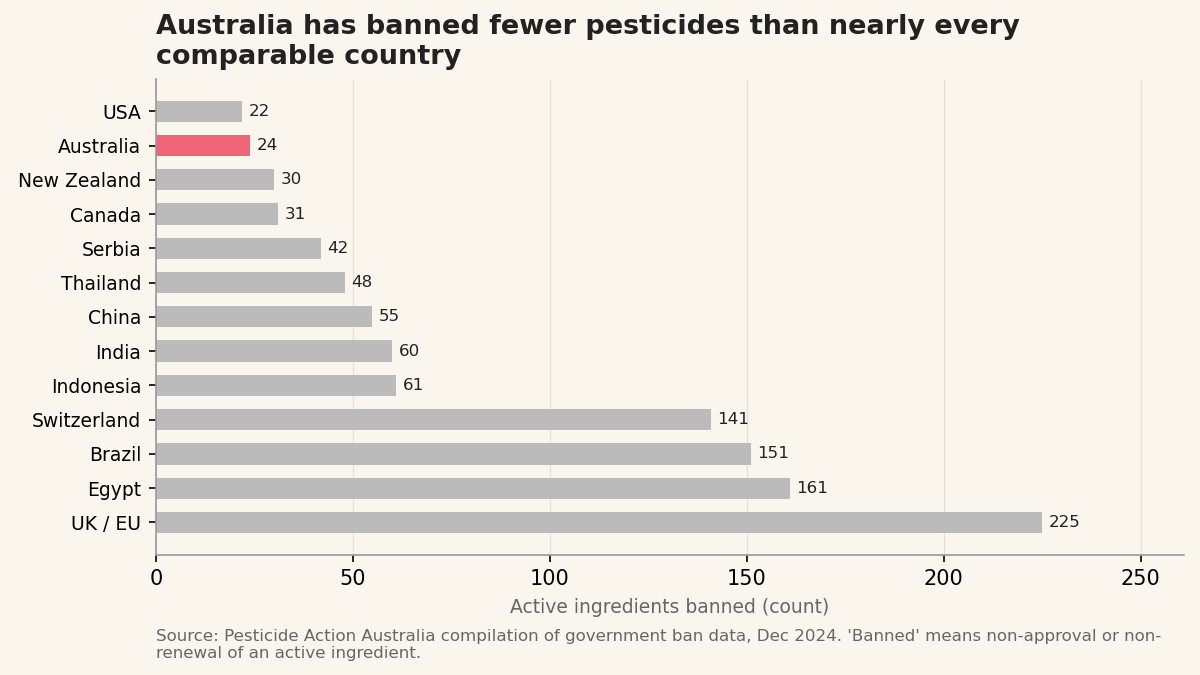
Counting non-approvals, Australia has banned 24 active ingredients. The UK and EU have banned 225. China, 55. New Zealand, 30. Only the United States sits lower, at 22.
Two cases show what that means in practice. Paraquat, banned in at least 74 jurisdictions including China, survived a 30-year Australian review in June 2026 with use restrictions. More than 70 Australian neurologists told the regulator their submissions were ignored; they cite studies putting paraquat-linked Parkinson's risk at about threefold. The regulator found the epidemiology insufficient, and the scientific literature genuinely splits on causation, but peer jurisdictions read the same data and banned the chemical.
Australia approved the insecticide isocycloseram before any other country in the world. The regulator finalised a 500-fold rise in the residue allowed on berries, with public consultation closing on 14 July 2026. The EU has never assessed it: no dossier, no safety review, nothing to approve.
The view from outside
In August 2026, Chinese authorities rejected 10 containers of Australian mung beans after border tests found glyphosate at five times China's limit. About 95% of the crop is sprayed with glyphosate before harvest to dry it, and growers told the ABC that correct use can still breach China's tighter rules.
One shipment is not a trade ban. Chinese inspectors tightened enforcement of rules they had always had. One routine border test exposed the gap. Their lab caught what Australia's own monitoring would never have found, because Australia tests almost none of its fresh produce.
What this means for cancer
The international evidence linking pesticide exposure to cancer is strongest for blood cancers and colorectal cancer, with childhood leukaemia linked to residential exposure. Australia contributes almost nothing to that evidence base: about 13,000 agricultural workers in the global AGRICOH consortium, against France's 128,000.
Australia's food carries a chemical basket weighted toward actives banned elsewhere. No Australian study can confirm or refute what that means for our cancer rates, because the exposure data does not exist. And the country's low cancer mortality, real as it is, is evidence about hospitals, not about chemicals.
The only Australian body-burden data comes from small, ad hoc studies. A South Australian study found widespread chronic exposure to organophosphate and pyrethroid metabolites in preschool children, with rural children carrying more. A Queensland study measured the same metabolites in children under five. No national program repeats that work.
What Australia must do first
Three reforms, in order of urgency.
1. The single most urgent move is a national human biomonitoring program: regularly testing a representative sample of Australians for chemicals in their blood and urine. The Senate PFAS committee recommended exactly this in November 2025, modelled on programs the United States, South Korea, Japan and several European countries already run. Every other reform on this list is unmeasurable without the baseline it would create. Europe's HBM4EU survey shows what the data looks like: 84% of sampled children and adults carried residues of two or more pesticides. Australia cannot produce its own version of that number today. A model built on published epidemiology puts the cost of not measuring at A$5.3 billion a year, with about 430 deaths.
2. Stop being the world's first mover. Australia should pause first-in-world approvals of new active ingredients and move to periodic re-approval with the onus on manufacturers to prove safety, on the EU's ten-year cycle. Chemical reviews that run for decades while products stay on sale have no deadline, and a review with no deadline never has to end.
3. Test what Australians eat. Residue testing of domestic produce should be mandatory and public, closing the FreshTest blind spot. Export commodities already get this discipline because importing countries demand it. Australians buying a bag of apples at home deserve the same.
Australia tests its exports but not its own food. It never samples its people. No country records cancer more often. No one has examined what connects them. Australia must start measuring.
Sources
- Bengtson Nash et al., "Australia's Blind Eye: Exploring the Nation's Permissive Stance on Harmful Pesticides", Environmental Science & Technology, 2026
- ABC Rural, "Fight erupts over 500-fold increase of 'forever chemical' on berries", July 2026
- APVMA, "Understanding isocycloseram and Maximum Residue Limits", statement confirming the final MRL decision after consultation closed 14 July 2026
- ABC News, "China's rejection of Australian mung beans prompts chemical rethink", August 2026
- Guardian Australia, "Who tests your food for pesticides in Australia?" and "Australian food is grown with dangerous chemicals banned in other countries", September 2022
- Rogers, Graham & Wang, "Pesticide Supply Chains From China to Australia", Journal of Agrarian Change, 2026
- Senate Select Committee on PFAS, Final Report, November 2025, and the Australian Academy of Health and Medical Sciences biomonitoring recommendation
- National Residue Survey, pome fruit results, Department of Agriculture, Fisheries and Forestry
- Babina et al., "Environmental exposure to organophosphorus and pyrethroid pesticides in South Australian preschool children", Environment International, 2012
- Li et al., "Pesticide metabolite concentrations in Queensland pre-school children", Environmental Research, 2019