Big business pockets $17 billion a year from pesticides that cost 430 Australian lives and $5.3 billion in disease and death.
Australia's pesticide trade adds A$17 billion a year to farm production, a number the industry commissioned and publishes. Australians pay A$5.3 billion a year for the damage: Parkinson's disease, lymphoma and other blood cancers, prostate and bowel cancer, and IQ loss in children that stays with them for life. The industry pays none of it. And the A$5.3 billion is the tip of the iceberg: it counts only the harm strong enough to model.
Of the roughly 15,700 Australians those diseases kill every year, the model attributes about 430 to pesticide exposure. Paraquat alone multiplies the risk of Parkinson's disease two and a half times. It is still sold in Australia. The regulator kept it in June 2026, at the end of a review that ran for thirty years.
Nobody ever paid to count the cost, so we counted it ourselves: an endpoint-level model, built entirely on published epidemiology and official valuation figures. It lands at A$5.3 billion a year, about A$510 for every household in the country. The full-transfer build reaches A$13 billion. This is the price of the blindness our earlier investigation documented: Australia tests almost none of its domestic food, never samples its people, and no longer even tracks what it sprays.
The industry's levies fund the regulator that approves the chemicals. The damage the chemicals do is billed to hospitals, to employers, to families, and to the people who die. An economist calls that an externality. A plainer word is a transfer: the profits are private and the invoice is public.
Banned elsewhere, registered here
Sixty percent of Australia's high-use pesticides are banned in the European Union. Eighty-four percent fail full approval anywhere. Paraquat is banned in at least 74 jurisdictions, including China. Glyphosate, the herbicide sprayed on 95% of the mung bean crop, is classified probably carcinogenic to humans by IARC, the WHO's cancer agency. Both are registered in Australia today.
The regulator has read the same studies and reached a different verdict. Its paraquat decision found the epidemiology insufficient. More than 70 Australian neurologists told it their submissions were ignored. The peer regulators who banned these chemicals read the same evidence and made the other choice. One of these positions costs 430 lives a year. The regulator has never said which one it thinks is true, because it has never paid to find out.
More land does not explain it
The industry's first defence will be that Australia is big, empty and farms a lot of land. The cropland numbers say otherwise. Australia's cropped area grew 84% between 1990 and 2023; its pesticide use grew tenfold. Normalised per hectare, Australia's intensity has risen more than fivefold while France and the United Kingdom cut theirs by about a third.
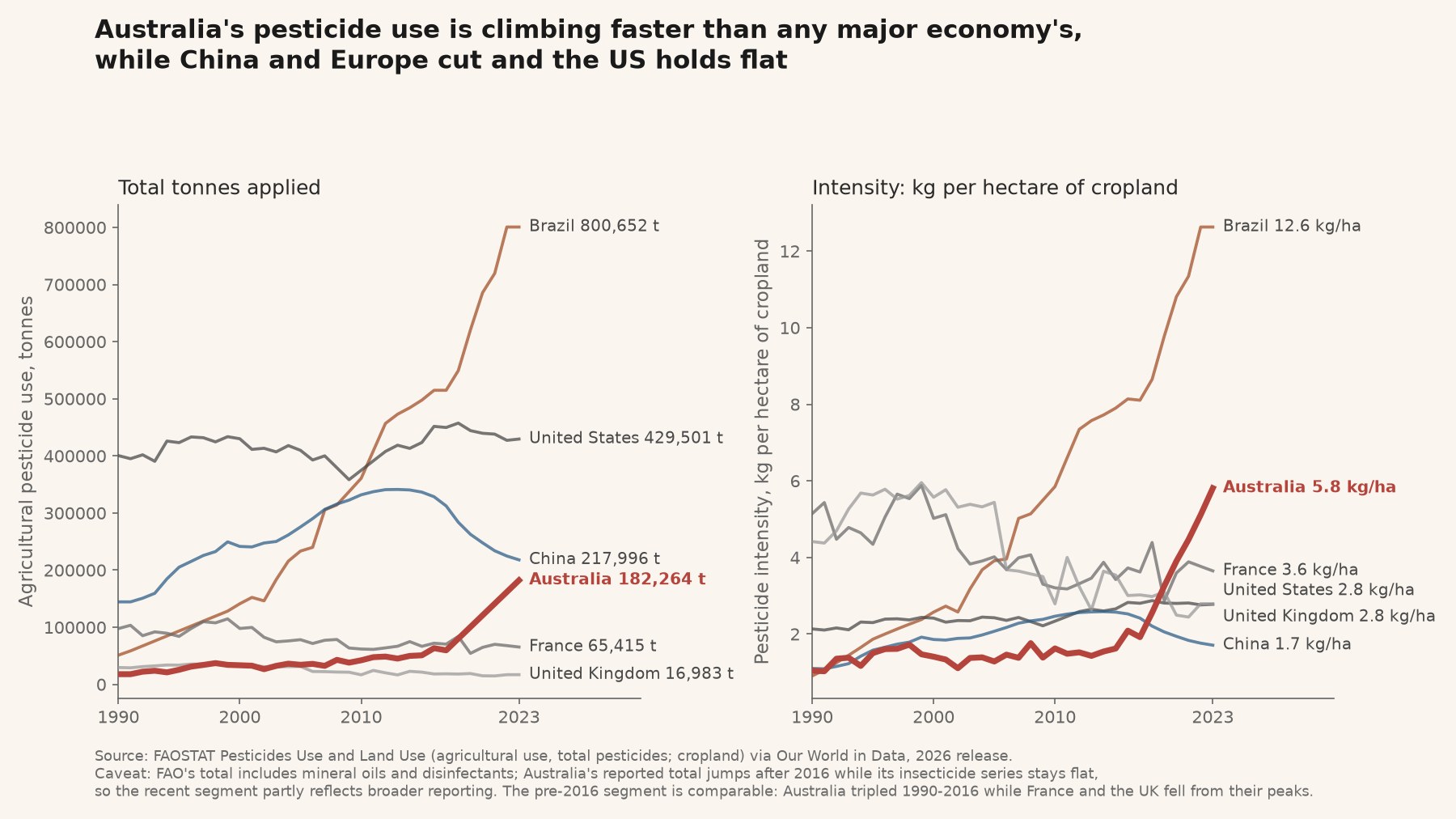
Pesticide use and intensity, 1990 to 2023
Tonnes applied and intensity per hectare of cropland
| Comparison criteria | Cropland 1990 -> 2023 (Mha) | Tonnes 1990 | Tonnes 2023 | kg/ha 1990 | kg/ha 2023 | kg/ha change |
|---|---|---|---|---|---|---|
| Australia | 17.1 -> 31.4 | 17,867 | 182,264 | 1.04 | 5.81 | +457% |
| Brazil | 56.5 -> 63.4 | 51,120 | 800,652 | 0.91 | 12.63 | +1295% |
| United States | 187.8 -> 154.7 | 400,522 | 429,501 | 2.13 | 2.78 | +30% |
| China | 131.3 -> 127.6 | 144,460 | 217,996 | 1.10 | 1.71 | +55% |
| France | 19.0 -> 17.9 | 97,701 | 65,415 | 5.14 | 3.65 | -29% |
| United Kingdom | 6.7 -> 6.1 | 29,517 | 16,983 | 4.41 | 2.79 | -37% |
Brazil is the only major user climbing as fast; its agriculture substitutes chemicals for land on a scale no other country matches. Every developed economy in the table bent its curve down. Australia's is still pointing up, and the two-panel chart above shows both views: total tonnes and intensity.
One caveat: FAO's total includes mineral oils and disinfectants, and Australia's reported total jumps after 2016 while its insecticide series stays flat, so the recent segment partly reflects broader reporting. The pre-2016 segment is comparable across countries, and it points the same way: Australia tripled its use while both European countries fell from their peaks.
Every objection ends at the same door
The A$5.3 billion is a model, and the objections to it are known in advance.
The number is built on European data. French and European studies supplied the exposure-response links because Australia has never measured exposure in its own people. The last national diet study used food bought in 2013. The government archived its pesticide usage database in 2022. European data is what you get when the measurement program does not exist.
The science is contested. The paraquat link is contested in the regulator's own review, while seventy neurologists cite a two-and-a-half-fold risk. Contests are settled with evidence, and the evidence that settles this one is body-burden data. Australia has none.
The margin of error is wide. The model's interval runs from A$4.5 billion to A$6.4 billion in its central build, and to A$13 billion if Australian exposure resembles Europe's. That interval is the size of the hole where the government's number should be.
Each objection is true. All of them argue for the same fix.
A national human biomonitoring program would test a representative sample of Australians for the chemicals in their bodies. The United States, Canada, Germany, South Korea, Japan and the EU already run one. The Senate PFAS committee recommended exactly this in November 2025. The Australian Academy of Health and Medical Sciences has asked for it. The government has not built it.
The invoice
None of these deaths is fate. Each one is the output of a choice the regulator makes again every year it keeps these chemicals on the market. For A$5.3 billion a year, the public subsidises the cheapest pesticides in the system: the ones other countries refused.
The industry counted its benefit and published the number. The public is still waiting for anyone in authority to count its cost. The 430 Australians who die from pesticide exposure every year deserve better than a model. Start measuring.
Sources
The cost model, with every input and its Monte Carlo, is published alongside this article.